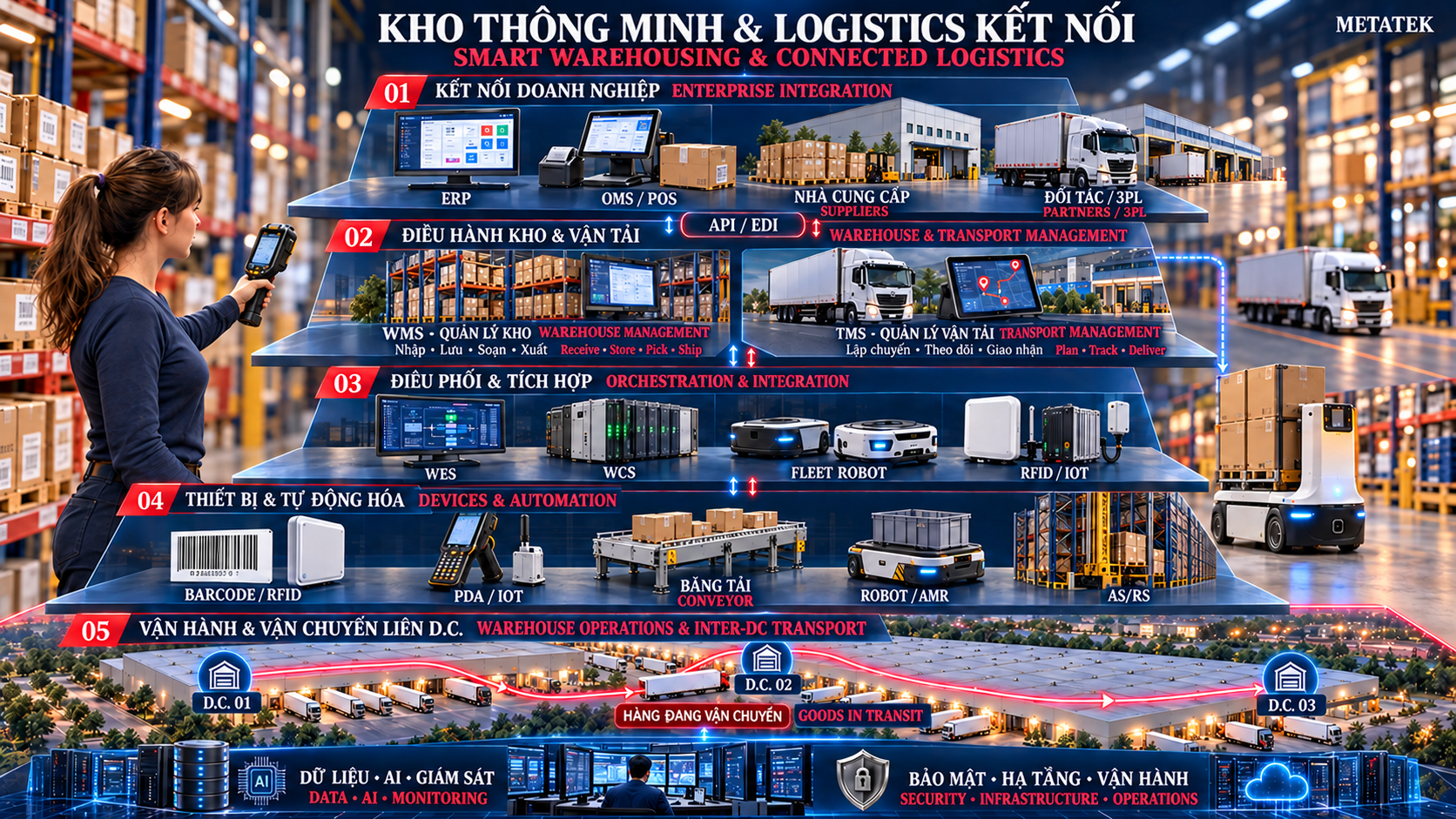
A barcode scan can confirm that goods have arrived. A connected operating system can help a business understand where those goods are stored, when they should be transferred, which transport option is appropriate, and which processes should be automated. This is the foundation of smart warehousing that delivers business value.
As businesses expand their networks of stores, factories, and distribution centers (DCs), operational complexity grows. Product ranges become broader, orders become smaller and more frequent, delivery expectations increase, and goods move continuously between locations.
One DC may hold excess inventory while another faces shortages. Warehouse employees spend time locating products, trucks wait because orders are not ready, and sales teams make phone calls to confirm available stock.
From a solution design perspective, smart warehousing needs to address three connected priorities: accurate inventory data, efficient warehouse operations, and end-to-end control of goods moving between locations.
1. Barcodes — a practical starting point for warehouse control
For businesses still relying on paper documents or manual data entry, barcodes provide a practical foundation for standardizing inventory transactions.
Implementation can begin with straightforward activities:
- Receiving: scan the product code, match it against the purchase order, and confirm the quantity received.
- Put-away:scan the product and storage location to record where goods are placed.
- Picking: use a handheld device to guide employees to the correct location, product, and quantity.
- Packing and dispatch: verify picked goods against the order before handover.
- Stock counting: scan the location, record quantities, and route discrepancies to the responsible person.
A critical design consideration is the relationship between product codes, units of measure, cartons, pallets, and storage locations. A product code does not necessarily identify a unique carton. Similarly, scanning a code does not automatically confirm the quantity inside unless the relevant packing data has been established.
When integrated with a warehouse management system, barcode transactions can also enable cycle counting by location or product group. Microsoft describes a cycle-counting process that includes creating counting tasks, recording results on mobile devices, and reviewing discrepancies before completion.
The value of barcodes comes from capturing information at the point of activity, reducing the gap between physical inventory and system records.
2. RFID — accelerating identification where scanning becomes intensive
When large volumes of goods require repeated individual scans, RFID — Radio Frequency Identification — is worth evaluating.
Under suitable deployment conditions, RAIN RFID can read multiple tags within a read zone without requiring direct line of sight to each code. GS1 identifies RFID as a technology that can complement barcodes, depending on requirements for speed, accuracy, and physical access to goods.
Potential applications include:
- Identifying pallets or cartons passing through receiving and dispatch gates.
- Counting tagged products using handheld readers.
- Tracking reusable containers, trays, roll cages, and other returnable assets.
- Comparing goods passing through a handover point with the expected dispatch or receiving list.
Performance must be validated using the actual products, packaging, and operating conditions. Metal, liquids, tag placement, and reader configuration can affect identification performance. GS1 also highlights the effects of metal and water on RAIN RFID.
A sensible deployment therefore starts with a pilot at one dock or within one product category, measuring missed reads, duplicate reads, and unintended reads from adjacent zones.
Standard RFID identification should also be distinguished from continuous positioning: detecting a tag at a read point does not mean its exact location is known at every moment.
3. WMS — turning identification data into operational decisions
Barcodes and RFID capture information. A Warehouse Management System (WMS) turns that information into tasks, priorities, and operating rules.
WMS design should begin with specific operational questions:
Where should newly received goods be stored? Which batch should be picked first? Can goods awaiting quality inspection be allocated? Who receives a replenishment task when a picking location runs low? Which orders must be completed before a truck’s departure time?
These questions define the capabilities that need to be configured:
- Storage locations, capacity, and storage conditions.
- Batch numbers, serial numbers, expiry dates, and quality status.
- FIFO — First In, First Out — or FEFO — First Expired, First Out — according to product requirements.
- Receiving, put-away, replenishment, picking, and counting tasks.
- Order grouping, picking zones, and progress monitoring against dispatch schedules.
For products with expiry dates, allocation rules should also consider the minimum remaining shelf life accepted by the receiving party. High-value goods may require serial-level traceability and transaction records identifying the employee involved. Fast-moving products may require different storage positions to reduce travel time.
Effective WMS design starts with the characteristics of the goods and the way the business serves its customers.
4. Inter-DC logistics — maintaining control while goods are in transit**
For businesses operating multiple distribution centers, warehouse optimization needs to work together with network-wide coordination.
A transfer between an origin DC and a destination DC should follow a controlled process:
1. Identify transfer requirements: assess available inventory, replenishment needs, and required delivery dates. 2. Plan transportation: consolidate goods by route, vehicle capacity, storage conditions, and receiving schedules. 3. Pick and verify: confirm the correct goods, handling units, and destination. 4. Record handover at the origin: capture actual dispatch quantities, trip details, carrier information, and seal references where applicable. 5. Monitor the journey: update shipment status, estimated arrival times, and exceptions. 6. Receive at the destination: reconcile actual receipts and record shortages, damage, or incorrect items. 7. Close and reconcile: complete the transfer and resolve discrepancies, documents, and costs.
Goods in transit must be managed as a separate inventory status. After leaving the origin DC, goods should become available at the destination only after the appropriate receiving confirmation.
Consistent identification of cartons and pallets helps both ends of the transfer work with the same information. Under GS1 guidance, the Serial Shipping Container Code (SSCC) identifies a logistics unit, while an Advance Shipping Notice (ASN) allows the receiving location to compare arriving goods with previously transmitted data.
At the coordination layer, a Transportation Management System (TMS) enables transport planning and the selection of suitable shipping options. Microsoft documentation describes how transfer orders can be included in transportation planning and how load building can consider vehicle constraints.
A connected solution should also consider dock appointments, carrier status updates, and electronic proof of delivery. For temperature-sensitive goods, temperature monitoring and alerts can be added according to storage and transport requirements.
The objective is to reduce truck waiting time, improve handover information, and allow operations teams to respond proactively to delivery risks.
5. Robotics and automation — selecting technology around operational bottlenecks
Once data and processes are stable, businesses can evaluate automation at specific stages.
| Technology | Potential application | Key evaluation factors | |---|---|---| | Conveyors and automated sortation | Move cartons between zones and sort them by destination | Throughput, carton dimensions, and flow stability | | Autonomous Mobile Robots — AMRs | Transport totes or cartons and assist picking operations | Travel distance, floor conditions, warehouse traffic, and handover points | | Automated Storage and Retrieval Systems — AS/RS | Automatically store and retrieve goods | Storage capacity, product characteristics, and peak-hour throughput | | Robotic arms | Picking, palletizing, or configured packing activities | Product consistency, gripper design, packaging quality, and safety |
It is important to distinguish transport robots from piece-picking robots. In many operating models, robots bring containers or goods to a workstation, while employees pick individual products. For example, the AutoStore solution presented by Dematic uses robots to retrieve bins and deliver them to ports for picking or replenishment.
International deployments demonstrate the scale at which robotics is being used. In June 2024, DHL announced 500 million cumulative picks assisted by Locus robots, with deployments at more than 35 facilities. This is a reported cumulative activity milestone; site-specific productivity gains and payback periods require separate assessment.
Robotics evaluation should consider the capacity of the entire process: picking, packing, sorting, and dispatch. Accelerating one stage without sufficient downstream capacity can create a new queue elsewhere.
6. AI — improving forecasting and coordination with reliable data
Once warehouse and transport data are recorded consistently, businesses can evaluate AI for:
- Forecasting demand by DC, store, and season.
- Recommending replenishment and stock transfers.
- Suggesting storage changes based on dispatch frequency.
- Predicting picking delays, late departures, or dock congestion.
- Identifying unusual transactions that require investigation.
Recommendations need to consider actual business constraints, including shelf life, minimum stock levels, transport schedules, transfer costs, and receiving conditions.
High-impact decisions should include approval mechanisms, traceability, and post-implementation performance reviews.
7. An investment roadmap — measurable value at every stage
Metatek recommends a phased approach aligned with operational maturity.
First, standardize data and transactions. Establish consistent product codes, units of measure, locations, and packing configurations, then introduce barcode-based recording at critical points.
Next, connect warehouse operations with the distribution network. Strengthen WMS processes, integrate enterprise systems, control transfers and in-transit inventory, and introduce TMS capabilities where coordination requirements justify them.
Then, pilot technology at the bottleneck. Select RFID, AMRs, conveyors, or other solutions based on measured operating data and pilot results.
Finally, scale and optimize. Evaluate outcomes through inventory accuracy, correctly picked order lines per hour, order processing time, truck waiting time, on-time and in-full delivery, and cost per order or transport trip.
Financial evaluation should include software, equipment, integration, infrastructure, maintenance, consumables, and training. Labor hours saved should be linked to achievable cost reductions or additional operating capacity.
From Metatek’s solution perspective, smart warehousing should be built on control of individual handling units, connected handovers, and automation that delivers measurable results. When warehouses and logistics operate on a shared flow of information, businesses gain a stronger foundation for expanding their distribution networks and improving customer service.