Information Technology Support (IT Support) — technology support services — needs to be organized around each chain’s actual operations. There is no engineer-to-store ratio that suits every business. The model needs to be built around operating hours, critical equipment, request volume, and travel conditions.
MEASURE THE WORKLOAD BEFORE FINALIZING HEADCOUNT
Metatek recommends compiling requests by location, time, and type of support required. It is important to distinguish work that can be handled remotely from work that requires an engineer on site, while also recording travel time and vendor coordination.
A location with few requests may still need a tailored approach if disruptions have a significant impact. For example, an incident affecting payment processing during peak hours has a different priority from a request to configure a device that is not yet in use.
Allocating staff based solely on call volume can therefore overlook important needs. What matters is understanding which operations are affected and which resources are best suited to address the issue.
REDUCE REPETITIVE WORK BEFORE EXPANDING THE TEAM
Google SRE uses the term “toil” to describe operational work that is manual, repetitive, and tends to grow with scale. [1]
In chain support, this work can arise in familiar steps: asking again for store details, confirming equipment, looking up support history, or sending the same instructions repeatedly.
Standardizing how requests are recorded is a practical starting point. Each request should include the location, relevant equipment, symptoms of the issue, level of impact, and contact person. With complete information from the outset, the support team has a basis for classifying requests and preparing an appropriate response.
Simple operating instructions need to be clear, within the appropriate scope, and suitable for users. Do not shift risky procedures to store employees merely to reduce engineer visits.
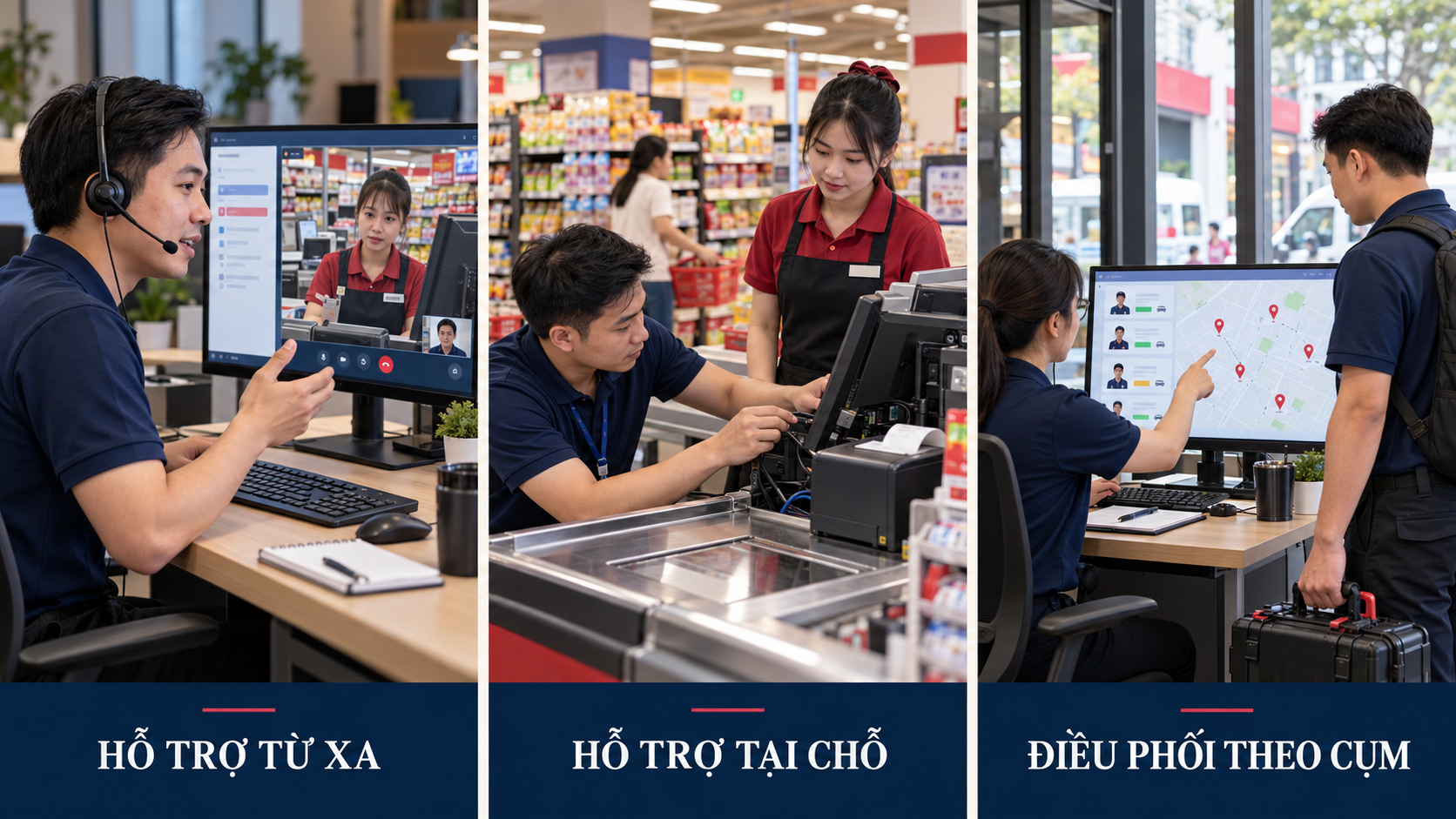
COMBINE REMOTE, ON-SITE, AND LOCATION-CLUSTER SUPPORT
Remote support is suitable for situations that can be investigated and resolved within the access permissions granted. This approach can reduce unnecessary trips and make it easier to receive requests from multiple locations.
On-site staff are suitable for locations with frequent needs or those requiring direct coordination with operations.
Cluster-based engineers serve groups of stores in the same area, based on workload, traffic conditions, and agreed service levels.
These three approaches can complement one another. The plan needs to account for peak hours, staff absences, and incidents occurring at multiple locations simultaneously. Travel time should not be estimated solely from distances on a map.
COMPARE COSTS AT THE SAME SERVICE LEVEL
When evaluating in-house staffing and outsourced services, businesses need to use the same basis for coverage hours, scope of work, coordination effort, travel time, and vendor dependencies.
A lower quote that covers fewer hours or excludes more work does not fully reflect cost-effectiveness.
Service objectives should be tied to user needs rather than measuring only the support team’s internal activities. This is also an approach informed by Google SRE. [2]
For store chains, businesses can track request acknowledgment time, when operations resume, recurring requests, and the effort employees spend following up. Metrics need to be clearly defined according to the actual scope and conditions of service.
TEST THE MODEL BEFORE ROLLING IT OUT ACROSS THE CHAIN
Metatek works with businesses to select a suitable group of locations to evaluate resource allocation. During the trial, track total handling time, number of trips, outstanding work, and user feedback.
The results provide a basis for adjusting the scope of remote support, location clustering, on-site schedules, and coordination arrangements with relevant vendors.
The goal is to create a model that remains sustainable as the chain grows, rather than committing to a fixed percentage reduction in staffing before evaluation data is available.
Metatek SUPPORTS CHAIN OPERATIONS
Metatek starts by understanding how the business currently operates: when stores are open, which systems directly affect customer service, and which requests consume significant staff time.
Based on that current state, consulting focuses on clarifying scope, responsibilities, request intake procedures, and a resource allocation model suited to the budget and expansion plan.
The intended value is to reduce coordination effort, provide visibility into resolution progress, and limit disruptions, allowing store teams to focus more on customers and business activities.
REFERENCES
[1] Google SRE — Eliminating Toil: https://sre.google/sre-book/eliminating-toil/
[2] Google SRE — Service Level Objectives: https://sre.google/sre-book/service-level-objectives/
Editorial note: The scenarios and approaches in this article are for reference only and do not describe the results of any specific client. Their application needs to be assessed against the business’s actual conditions.
Work with Metatek to assess your current support setup, resource-intensive tasks, and an approach suited to your chain’s growth plans.