
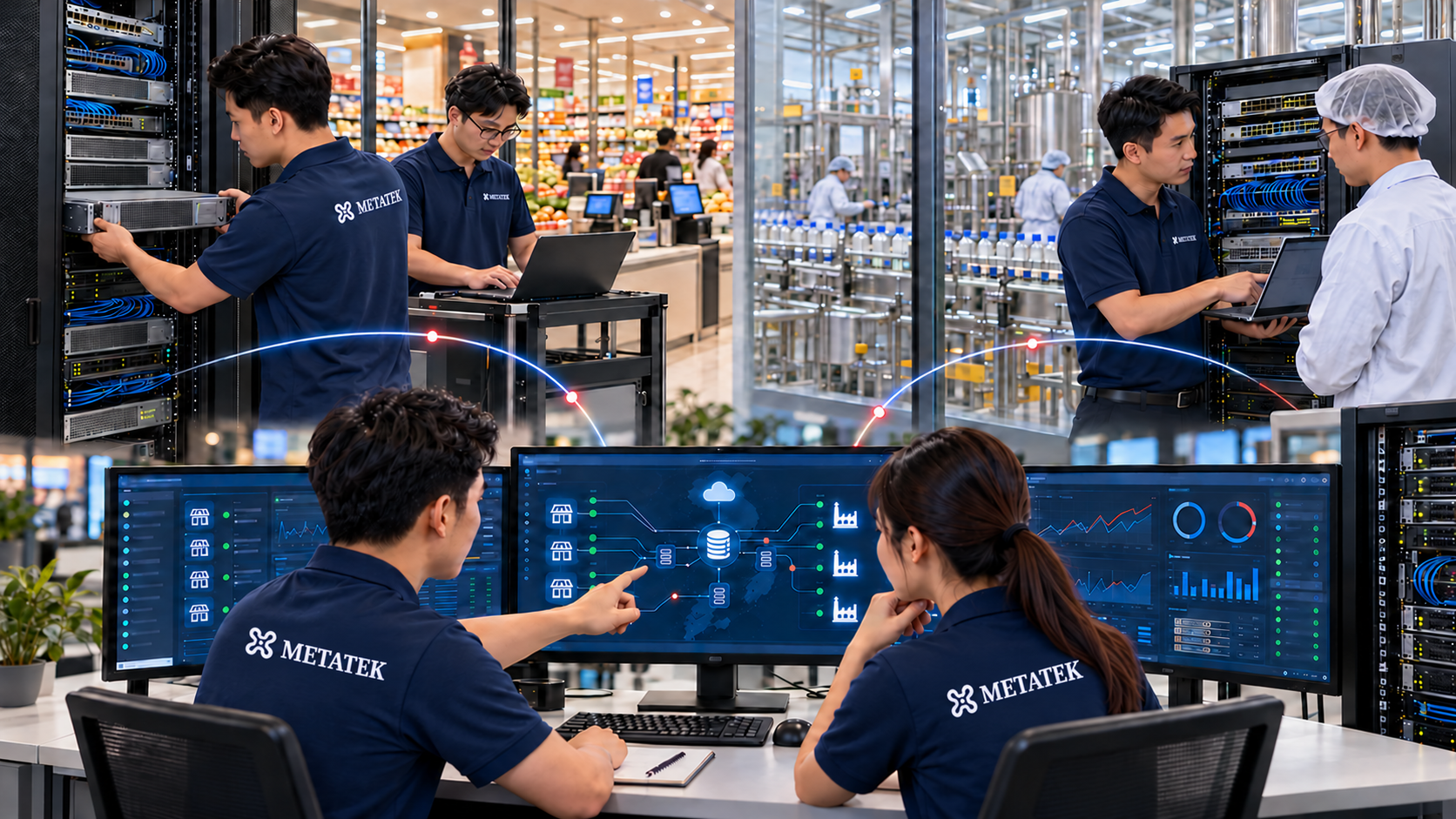
AI creates opportunities to reduce manual work and improve operational efficiency. To seize those opportunities, businesses need suitable infrastructure and networking foundations: making use of existing assets, meeting actual needs, and providing a clear roadmap for expansion.
A retailer wants to use AI to process documents, support employees, and analyze business operations. A factory wants to connect production data to its management system. A company expanding its branch network needs employees to access applications conveniently while keeping its technology budget under control.
These needs can lead to very different investment options.
Before upgrading servers, increasing bandwidth, or purchasing additional equipment, businesses need to identify which tasks are being slowed down, where their data resides, and what their systems need to deliver.
START WITH THE BUSINESS NEED
Artificial Intelligence (AI) can be used through off-the-shelf software, external services, or privately deployed models. Each approach brings different requirements for connectivity, data, processing capacity, and operations. Infrastructure planning therefore needs to clarify: Which tasks and user groups will AI support? How many people will use it simultaneously, and when? Where will the data come from, and who will have access? What level of delay or disruption directly affects the business? How much budget and operational capacity can the business allocate?
For infrastructure running self-hosted AI models, NVIDIA's guidance also bases resource sizing on the use case, workload, and actual response requirements. This approach provides a basis for informed configuration choices, rather than investing based on untested expectations.
WHAT DOES THE INFRASTRUCTURE AND CONNECTIVITY SOLUTION PACKAGE INCLUDE?
Metatek proposes a solution structure comprising five categories. The specific scope is selected according to each business's current environment and priorities.
Category Areas to review Intended value
CURRENT ENVIRONMENT ASSESSMENT
Review equipment, applications, connectivity, utilization, and dependencies
Identify what can be reused and what needs priority attention
NETWORKING AND CONNECTIVITY
Local networks, Wi-Fi, internet connections, branch connectivity, and redundancy options
Enable convenient application access and minimize disruption
SERVERS AND DATA
Processing capacity, storage, deployment environments, and expansion needs
Allocate resources appropriately for the work
SECURITY AND RECOVERY
Access controls, network segmentation, backups, recovery testing, and incident response coordination
Protect data and be prepared for incidents
MONITORING AND COSTS
Track system health, utilization, licensing, and recurring expenses
Provide a basis for adjusting resources and budgets
The solution package is developed as an operational plan that connects these categories, with clear responsibilities and deliverables.
RELIABLE CONNECTIVITY FOR SMOOTH WORKFLOWS
When applications and data are used across multiple locations, connection quality becomes part of the working experience.
Store employees need access to sales systems; warehouse teams need to update transactions; managers need to view reports; and AI users need access to data within their authorized scope.
Metatek recommends assessing connectivity for each workflow: where requests originate, which applications serve them, when peak loads occur, and what happens if a connection fails.
Performance, operational continuity, and security are also factors Cisco emphasizes in its guidance on network infrastructure for AI. [2]
The goal is to address the right bottlenecks so that investment delivers improvements users can notice and verify.
CHOOSE DEPLOYMENT LOCATIONS BASED ON ACTUAL NEEDS
On-premises — deployment at the business; Cloud — cloud computing; and Hybrid — a combination of both are options that should be compared against the same requirements.
Metatek recommends considering utilization, data, connectivity, management capabilities, and total cost together.
For needs still being tested, a flexible option may be suitable for validation before committing to long-term investment. For stable workloads, businesses need to assess resource utilization efficiency and their ability to maintain operational control.
A hybrid model requires clarity on where applications reside, which points data passes through, and which party is responsible when disruptions occur. An option only has value if the business can manage it in practice.
DESIGN FOR RETAIL, MANUFACTURING, AND OFFICE ENVIRONMENTS
For retail chains, Metatek recommends prioritizing point-of-sale operations, connectivity to centralized applications, access control, and multi-site management capabilities. When opening new stores, standardized configurations and support procedures make deployment, testing, and handover easier.
For manufacturers, the scope of connectivity between office networks, management systems, and production control environments needs to be clearly defined. Upgrades must be coordinated around operating schedules, equipment requirements, and the responsibilities of the vendors involved.
For offices and service businesses, priorities may include the application user experience, remote access, shared data, and AI use cases that support everyday work.
Even with the same goal of adopting AI, the investment roadmap needs to reflect the specific nature of business operations.
OPTIMIZE COSTS ACROSS THE ENTIRE LIFECYCLE
Equipment purchase prices or resource rental fees are only part of the budget. When comparing options, businesses also need to consider licensing, storage, backups, data transfer, electricity, maintenance, and administrative effort.
FinOps — a collaborative approach to managing technology value and costs — emphasizes understanding usage, connecting costs to business value, and continuously optimizing. [3]
Following this approach, Metatek recommends reviewing expenses that can be adjusted: underused resources, services with overlapping functions, licenses that are no longer needed, or unsuitable configurations.
Every cost-cutting decision needs to be considered alongside its impact on work. An effective option must maintain the service level the business actually needs.
IMPLEMENT IN PHASES, EVALUATE BY RESULTS
Metatek recommends starting with a scope that can be validated, such as a user group, a cluster of stores, or a data processing workflow.
Agree on appropriate metrics before and after implementation: task completion time, disruptions, resource utilization, support effort, and ongoing costs.
The results provide a basis for adjustments before scaling up. The scope of AI applications, integration, and licensing is also clarified for each use case.
Metatek supports businesses from assessment and solution planning through implementation, handover, and operations within the agreed scope. The intended value is a technology foundation that fits current operations, can scale, and is managed within a clearly defined budget. Invest in the right areas today to create room for future growth.
DISCUSS YOUR INFRASTRUCTURE AND AI ADOPTION PLANS WITH METATEK EXPERTS →
REFERENCES
[1] NVIDIA — Selecting AI processing capacity based on workloads and total cost of ownership. [2] Cisco — Infrastructure for the AI era. [3] FinOps Foundation — Outcome categories in technology value and cost management.
The solution package structure is a proposal from Metatek and is adjusted following an assessment. Specific outcomes and costs need to be evaluated based on the business's current environment, scope, and operating conditions.