Emails fail to send, connections become unstable, or a computer containing important documents stops working. In a solo business, the owner usually handles these problems. In small and medium-sized enterprises—SMEs—the responsibility may fall to an administrator or someone who is “good with computers.”
When disruptions keep recurring, the question arises: Should you hire your own IT employee or use an external service?
The decision requires a clear view of the workload, support requirements, and total cost—including time lost when systems encounter problems.
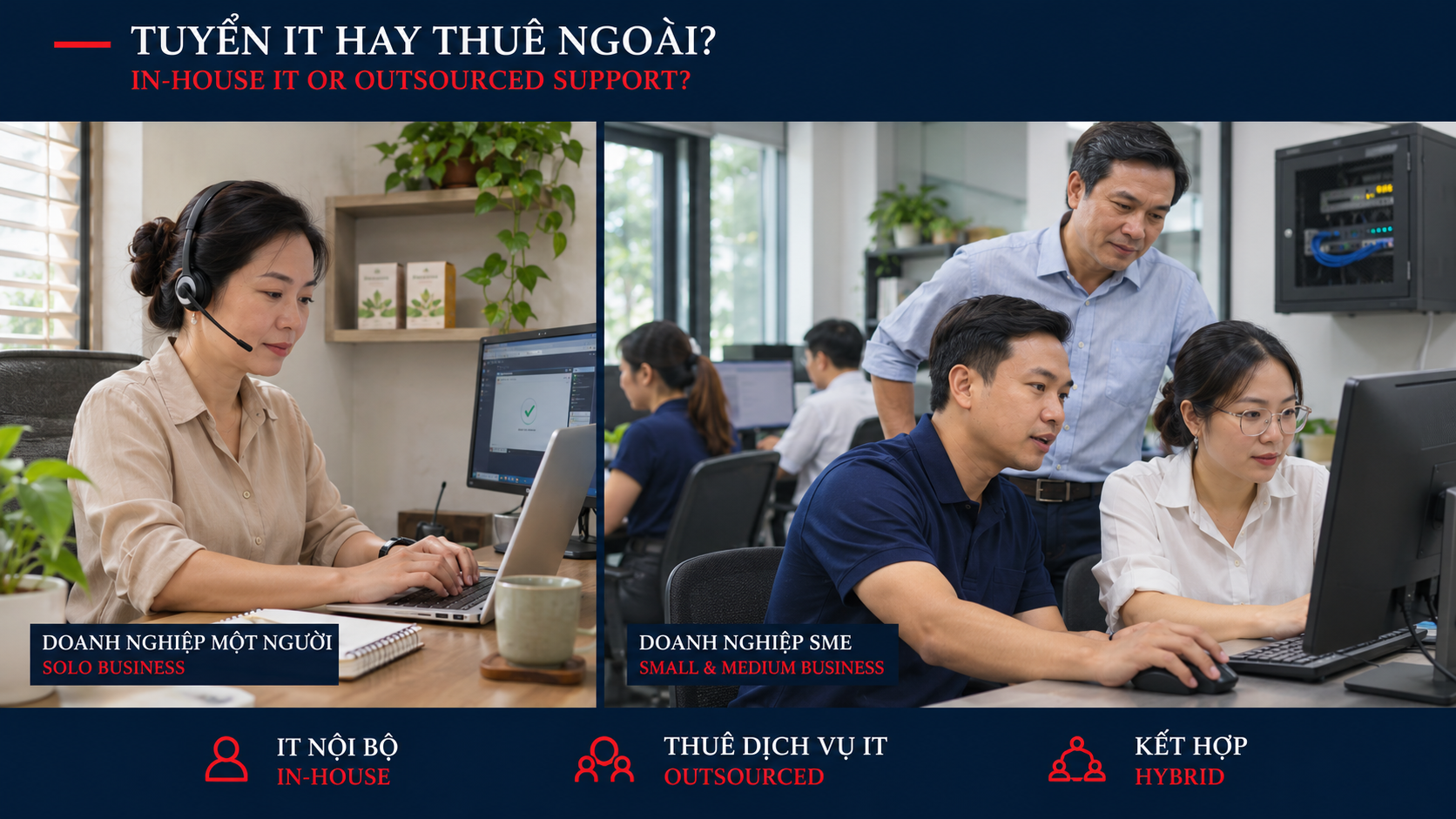
Solo businesses: you may not need a dedicated employee yet, but you still need support
If your business mainly uses a laptop, email, accounting software, and online tools, the support workload will often be insufficient to justify a full-time IT position. Initial setup, periodic checks, and support when needed may be a suitable alternative.
Essential tasks still need attention: protecting accounts, backing up data, managing software, and preparing recovery procedures. Overlooking seemingly minor tasks can directly affect your ability to serve customers.
Handling everything yourself also has a cost. As an illustrative example, an owner spending four hours a week resolving IT problems loses 16 hours over four weeks—time that could otherwise support sales and business development.
Businesses developing technology products should assess product engineering staffing separately from office IT support.
SMEs: when does in-house IT make sense?
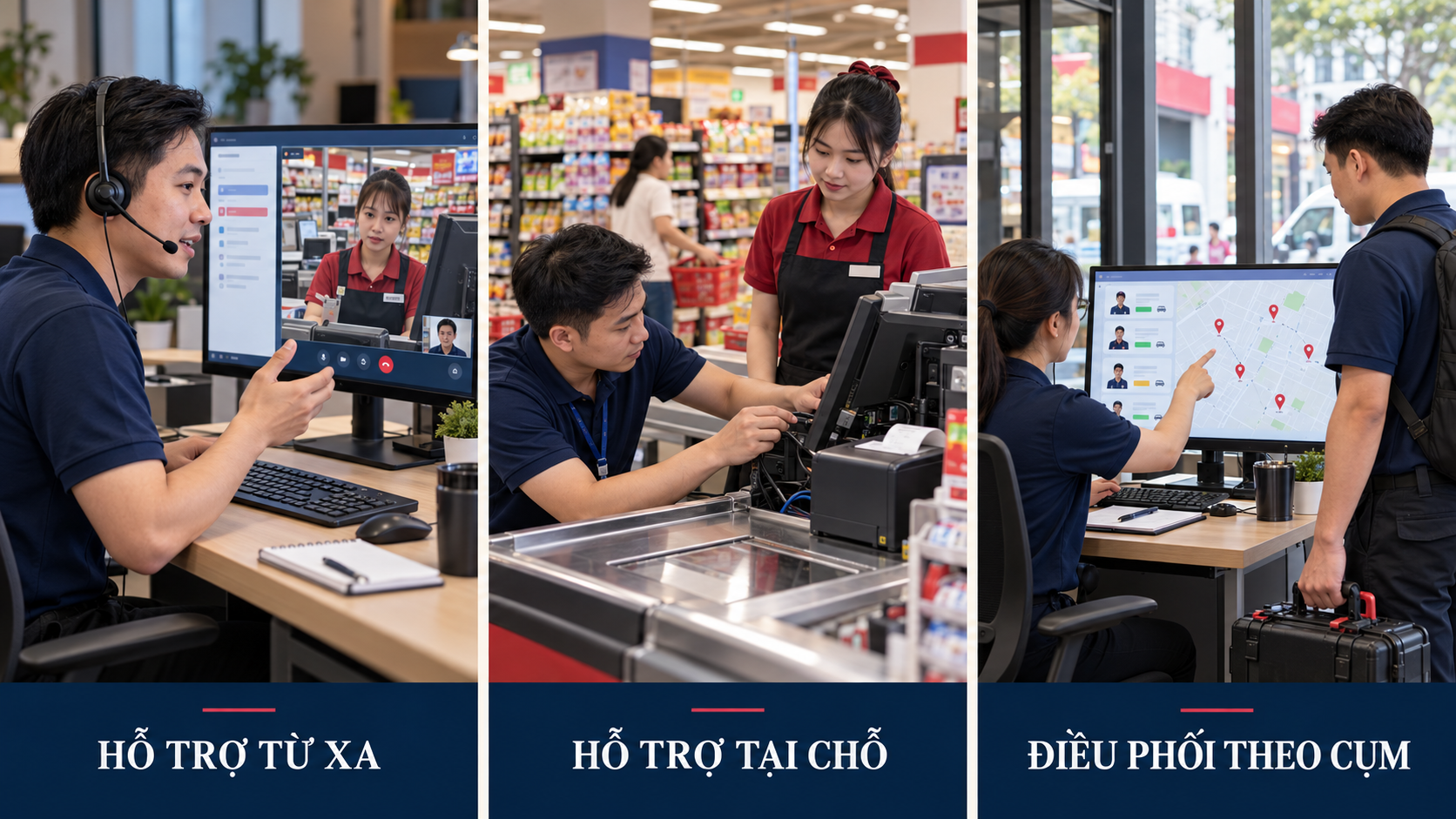
Headcount is only one consideration. A consulting firm using online applications may receive most support remotely. A business operating stores, warehouses, or factories may need on-site assistance with network equipment, POS terminals, and operational systems.
In-house IT is suitable when tasks arise consistently every day, require an on-site presence, and demand a deep understanding of business processes. The advantages include close involvement in operations, prompt coordination with departments, and accumulated knowledge of the systems.
However, one employee is unlikely to cover every specialty. The business still needs replacement coverage during absences and additional expertise when problems exceed that employee’s capabilities.
When is outsourced IT support suitable?
Outsourcing may be appropriate when demand fluctuates, many tasks can be handled remotely, or different expertise is needed at different times.
Businesses can access a support team within an agreed scope. In return, the provider needs assessment and onboarding time to understand the systems and business processes. On-site availability, backup staffing, and additional work must be clearly agreed.
For SMEs requiring a regular internal contact, a combined model is also worth considering in-house IT handles daily tasks, while an external team provides specialist expertise and backup support.
Compare total costs, not just salaries and service fees
ITviec’s 2025–2026 report lists median monthly salaries for IT Support/Helpdesk professionals at VND 18.7 million for those with 3–4 years of experience and VND 22.5 million for those with 5–8 years. This equates to approximately VND 224.4–270 million for 12 months of salary, before other expenses. These are survey benchmarks, not salary levels applicable to every SME.
Hiring also involves recruitment, benefits, training, tools, and replacement coverage. For outsourced services, check included on-site visits, support hours, geographical coverage, and separately charged work.
A fair comparison requires the same scope and service requirements. Compare device counts, locations, support needs, and responsibilities before deciding which option is more economical.
Outsourcing works best when responsibilities are clear
Before signing, establish which devices and applications are covered, how quickly support will respond, when on-site assistance will be available, and which tasks incur additional charges. Access permissions, change approvals, and the handover of administrator accounts must also be defined.
The NCSC’s guidance for SMEs emphasizes scope, responsibilities, service commitments, and reporting. In particular, response time differs from resolution time; the two should be agreed separately.
Metatek supports businesses at each stage of growth
Metatek helps assess existing arrangements and develop suitable options: on-demand support, recurring services, or collaboration with in-house IT.
For solo businesses, the priority is reducing time spent troubleshooting and protecting essential data. SMEs also need operational continuity, support across locations, and clearly assigned responsibilities.
Hire in-house IT when there is sufficient ongoing demand for the role. Outsourced services can supplement missing capabilities at each stage, with a clearly defined scope and controlled costs.